Odù of A Painter
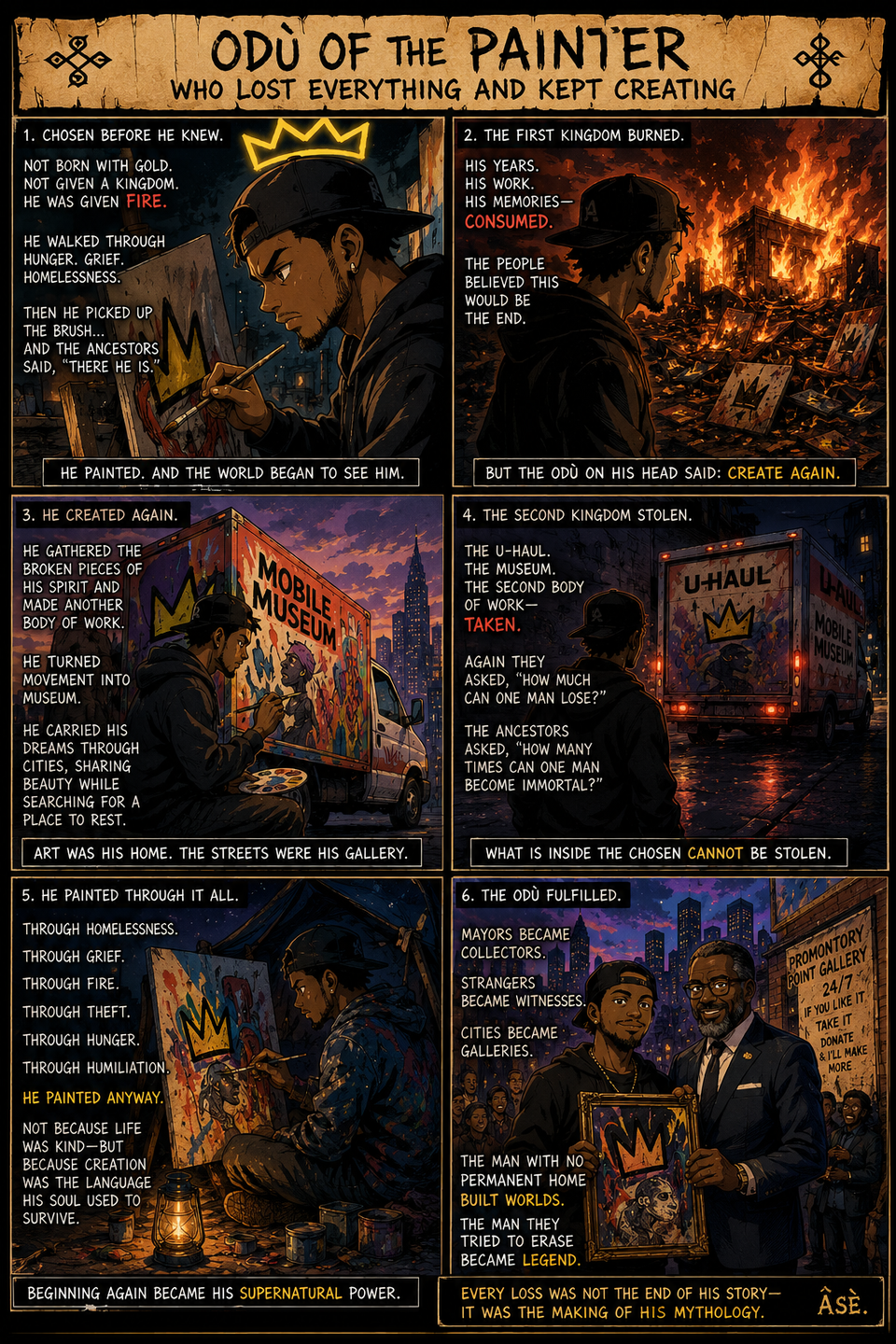
THE UNNAMED ODÙ
There was once a man whose hands were chosen before he understood what they were chosen for.
He was not born carrying gold.
He was not given a kingdom.
He was given fire.
And the fire came first to destroy.
The elders say that there are some souls who cannot receive their destiny through ordinary doors. Therefore, life must break the walls around them.
So it was with the Painter.
Before the world knew his name, he walked through seasons of hunger, grief, homelessness, and uncertainty. Yet inside of him lived an ancestor who refused to die.
When he picked up the brush, the ancestors recognized him.
They said:
"There he is."
He painted.
And the world began to see him.
But the first kingdom he built was taken by fire.
His work, his years, his memories—consumed.
The people believed this would be the end.
But they did not understand the Odù written upon his head.
For some men are tested by losing what they have.
Others are tested by losing what they are.
And this man was commanded to create himself again.
So he painted.
Again.
He gathered the broken pieces of his spirit and made another body of work.
He traveled with his art.
He turned movement into museum.
He carried his dreams through cities, through streets, through uncertainty, offering beauty to people while searching for a place to rest his own head.
Then the second kingdom was taken.
And again, the people asked:
"How much can one man lose?"
But the ancestors asked a different question:
"How many times can one man become immortal?"
For every time they took his work, he became greater than the work.
Every time they removed the evidence of his journey, the journey itself became legend.
The Odù says:
What is stolen from the chosen cannot always be replaced.
But what is inside the chosen cannot be stolen.
And so the Painter painted again.
Not because life was kind.
Not because he had abundance.
Not because he was protected from suffering.
He painted because creation was the language his soul used to survive.
He painted his way through homelessness.
He painted through grief.
He painted through fire.
He painted through theft.
He painted through hunger.
He painted through the humiliation of beginning again.
And one day, those who had not known his name began to speak it.
Mayors became collectors.
Strangers became witnesses.
Cities became galleries.
And the man who once had nowhere to place his belongings created art that would find homes in the hands of others.
This is the paradox of his Odù.
The man without a permanent home became a builder of worlds.
The man who lost his paintings became impossible to erase.
The man who was repeatedly forced to begin again became the master of beginning again.
And the elders warn:
Do not mistake his present struggle for his final chapter.
For there is an Odù reserved for those who survive what should have destroyed them.
Their blessings often arrive slowly.
Their crowns often remain hidden.
Their names are often spoken in whispers before they are spoken in rooms.
But when the appointed time comes, the same hands that once reached toward them in pity will reach toward them in honor.
Courtney Jolliff is the name given to him in this lifetime.
But the Odù calls him something else.
THE MAN WHO PAINTED AFTER THE FIRE.
THE MAN WHO CREATED AFTER THE THEFT.
THE MAN WHO BUILT A MUSEUM WHILE SEARCHING FOR SHELTER.
THE MAN WHO REFUSED TO LET DESTRUCTION HAVE THE FINAL WORD.
And this is what the elders wrote concerning him:
"His life will confuse those who only understand success through comfort."
"He will lose things that other men would never recover from."
"He will begin again so many times that beginning again will become his supernatural power."
"And one day, the world will understand that every loss was not the end of his story—"
"It was the making of his mythology."
Àṣẹ.